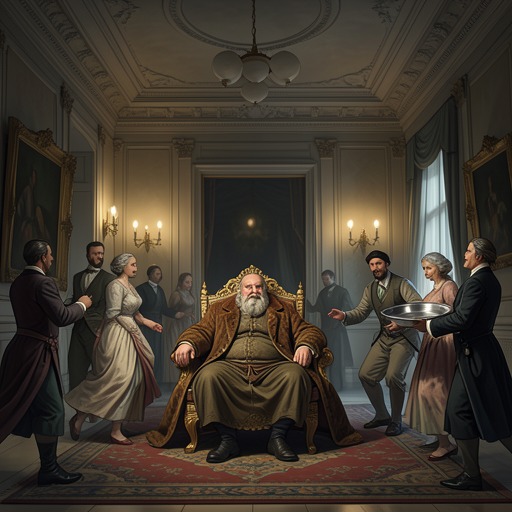
Free Will and Necessity
War and PeaceFree will and inevitability form a central philosophical problem in the historical argument. Human beings experience themselves as free because consciousness is inseparable from willing, yet every action appears, when examined from outside, to arise within a network of character, motives, circumstances, time, and social relations. History becomes possible only when these apparently contradictory dimensions are understood together rather than when one is used to cancel the other.
The Contradiction Between Consciousness and Law
Human beings encounter the problem from two opposed positions. As objects of observation, they appear subject to a general law of necessity, like everything else that exists. As conscious beings, however, they experience themselves as free. Reason observes the conditions governing action; consciousness knows the self as living through the act of willing. Because a person recognizes the will only as free, even the discovery that the will is consistently directed by causes is experienced as a limitation of freedom rather than as proof that freedom does not exist.
The text treats this consciousness as irreducible. A person may learn through experiment and argument that actions depend on organization, character, and motives, yet cannot accept the conclusion that the will is therefore wholly determined. The simplest act of lifting and lowering a hand is presented as an immediate demonstration of freedom, not because it escapes every cause, but because the awareness of volition cannot be replaced by an external description of the movement. Without some consciousness of freedom, human life itself would become unintelligible: every effort, impulse, ambition, and resistance would lose the meaning through which a person recognizes existence.
This duality extends into several fields of thought. Theology encounters it in the question of sin, jurisprudence in responsibility to society, ethics in conscience and judgments of right and wrong, and history in the question of whether the past results from free or constrained human activity. A person considered within the collective life of humanity appears governed by laws; the same person considered from within appears free. The contradiction is therefore not an accidental difficulty but a condition of thinking about human action.
Freedom and Inevitability in Historical Action
History does not need to solve the essence of free will in the abstract. Its subject is the manifestation of human will in the past, under definite conditions. Each historical action appears partly free and partly compulsory, and the proportion changes according to the observer's point of view. The migration of peoples, the decrees of Napoleon III, and an individual's choice of direction during a walk can all be understood through the same structure: each contains an element of conscious choice and an element of inevitability.
The relation is inverse. The more freedom an observer attributes to an action, the less necessity is perceived; the more clearly its determining conditions are understood, the less free and more compelled it appears. A drowning man who clutches another and drowns him, a starving mother who steals food, and a disciplined soldier who kills a defenseless person at a command seem less guilty to someone who knows the conditions surrounding them than to someone who sees only the completed act. Likewise, a murder committed twenty years earlier appears more inevitable when viewed across the intervening life than when judged immediately afterward, while the conduct of an intoxicated, insane, or intensely excited person appears less free to an observer who understands that mental state.
Three considerations determine this shifting judgment. The first is the actor's relation to the external world: family obligations, official duties, work, other people, and even the material surroundings of action exert influence and narrow the field of apparent choice. The second is the actor's relation to time. A recent action feels more freely chosen because its circumstances remain close to consciousness, whereas an action separated from the observer by years appears more deeply embedded in a chain of conditions and consequences. The third is the relation to causes: the more completely the motives and preceding circumstances are known, the more necessity becomes visible.
Yet neither concept can be reduced to zero. Complete freedom would require a person to exist alone, beyond space, time, and causation. Complete inevitability would require knowledge of every spatial relation, the whole duration of time, and an infinite series of causes. Such extremes would destroy the very object being described. If no freedom remained, there would be no human being whose action could be considered; if no inevitability remained, there would be no form or intelligible order in which an action could occur.
Reason, Consciousness, and the Form of Life
The argument gives reason and consciousness distinct but complementary tasks. Reason expresses the laws of inevitability: infinite space, continuous time, and the unending connection of cause and effect. Consciousness expresses freedom: the sense that the self alone is present, that the present moment is the point from which time is measured, and that the self is the cause of its own manifestations. These claims cannot be made to coincide by ordinary logic, because they arise from different sources of knowledge.
Freedom is therefore described as content, while inevitability is form. Freedom supplies the lived substance of human action; inevitability provides the structure through which that action can be observed, related to other events, and understood. Separating the two produces mutually exclusive abstractions: empty necessity on one side and an unconditioned freedom that would be nothing on the other. Their union, by contrast, yields a workable conception of human life. What is known about life is a relation between free will and inevitability, or between consciousness and the laws disclosed by reason.
The same pattern governs the language of the sciences. In experimental inquiry, known regularities are called laws of inevitability, while the unknown remainder is called vital force. In history, what has been explained through the laws of human life is treated as necessity, while what remains unknown is named free will. Free will thus does not function for history as an uncaused power that interrupts historical order; it marks the still-unexplained remainder of human activity.
The Method and Limits of History
History can be a science only by examining free will in connection with the external world, time, and causes. To recognize a human will as a force capable of influencing events while remaining wholly outside law would be as destructive to history as the admission of a freely moving heavenly body would be to astronomy: one exception would negate the possibility of general laws. Historical inquiry must therefore study the lines along which human wills move, with one end hidden in the unknown and the other visible in present consciousness, space, time, and causal dependence.
The wider the field of human movement that historical observation can survey, the more clearly its regularities emerge. This does not mean that individual consciousness is denied. Rather, the element called free will must be treated as infinitely small in relation to the immense movement of peoples and events. When historians seek the causes of events in an isolated person's supposedly independent will, scientific explanation becomes impossible; when they attend instead to the laws governing the combined activity of countless wills, history approaches its proper problem.
This framework also reshapes the meaning of historical judgment. An action cannot be understood solely by isolating the actor and assigning an absolute degree of freedom. Its apparent freedom changes with the observer's knowledge of social position, temporal distance, mental condition, and preceding causes. Historical explanation therefore joins moral consciousness to causal analysis without pretending that either can replace the other. The enduring paradox is not an error to be eliminated but the structure within which human action becomes both lived and knowable.